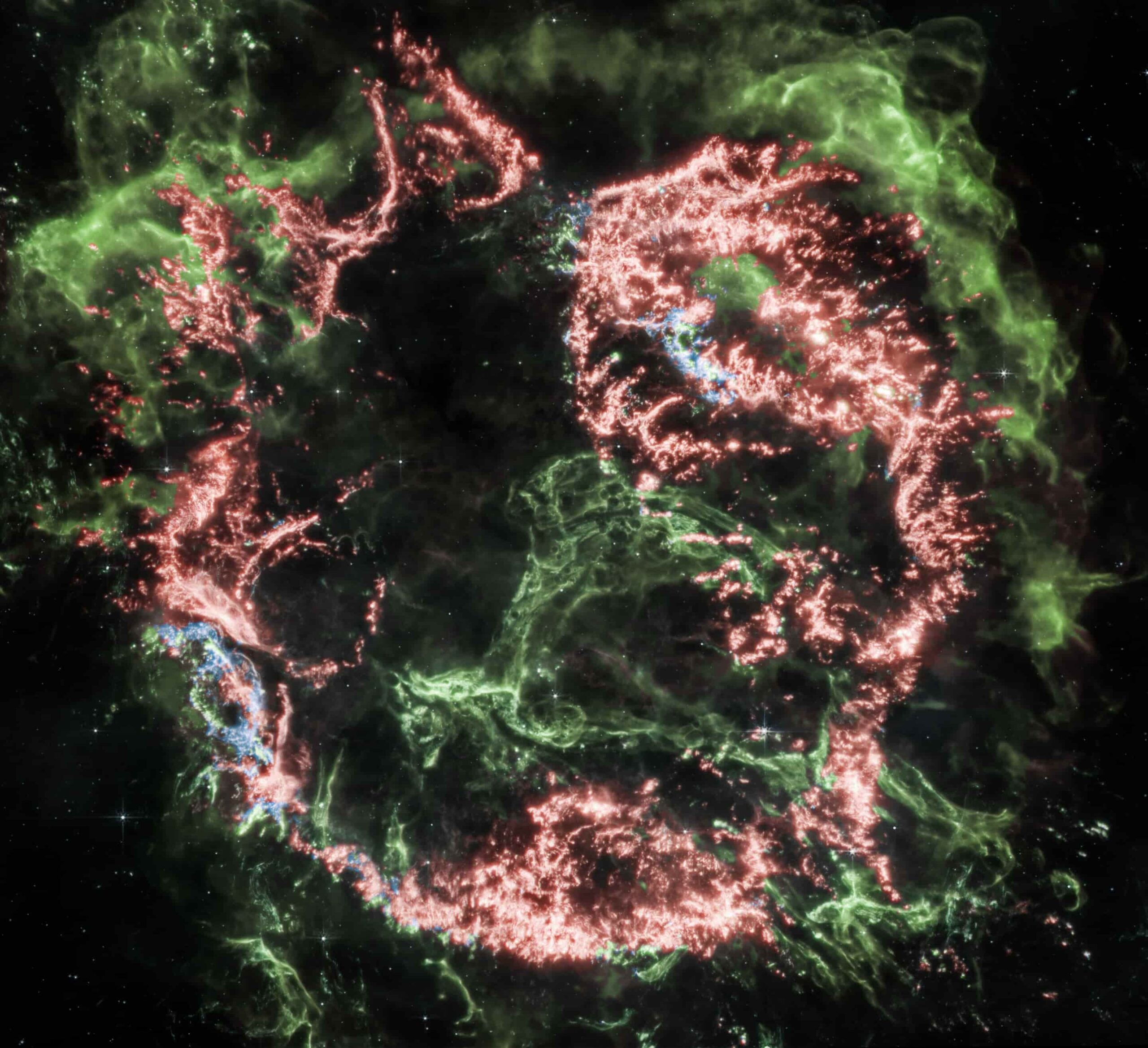
The James Webb Space Telescope has uncovered evidence that the inner layers of the massive star that created the supernova remnant Cassiopeia A (Cas A) may have begun merging just hours before its explosion. By mapping the chemical make-up of dust across the remnant, astronomers have found clues to a dramatic change inside the star shortly before its core collapsed.
What happens inside a massive star?
Stars form when vast clouds of gas and cosmic dust collapse under gravity. As the material heats up, a protostar develops; eventually, nuclear fusion converts hydrogen into helium and the star enters its long-lived main phase.
When hydrogen in the core is depleted, the core contracts and heats further. In massive stars, fusion proceeds through increasingly heavy elements, while different elements burn in surrounding layers. The result is a series of shells that preserve a record of the star’s evolution. In the final stages, turbulence and circulation can mix these layers, changing the star’s internal structure and the chemical material later expelled by the explosion.
Three regions reveal different kinds of dust
The research team used observations from NASA’s retired Spitzer Space Telescope to identify three regions for detailed follow-up with Webb. Two lie in Cas A’s reverse-shocked region, where an inward-moving shock wave encounters material thrown outward by the supernova.
Webb found that one of these regions is dominated by silica dust, while the other contains mostly carbon-rich dust. The third region, known as the Green Monster, is rich in complex magnesium silicates. Unlike the other two targets, this material was shed by the star before it exploded rather than being produced in the supernova ejecta.
How dust preserves clues to the star’s final hours
Dust grains form as some of the elements dispersed by a supernova cool and condense. Their composition can therefore preserve information about the layers in which those elements were produced. Webb’s improved resolution allows researchers to examine individual, roughly Solar-System-scale clumps rather than treating the remnant as a single blended cloud.
Lead author Tea Temim, a research scientist at Columbia University, said that material inside stellar shells can churn and circulate, potentially causing them to merge shortly before the explosion. One possible example is the merger of oxygen-burning and carbon-burning layers, a process that could substantially alter the star’s structure and the chemical abundances found in its debris.
Webb, Chandra and XRISM build a broader picture
The team combined Webb’s infrared observations with X-ray data from NASA’s Chandra X-ray Observatory and the Japan-led XRISM mission. Together, these observations enabled researchers to map dust chemistry across Cas A. The resulting map indicates that signs of layer mixing appear across much of the remnant, not only in the three regions initially selected for closer study.
Co-author Dan Milisavljevic of Purdue University noted that Webb’s ability to resolve individual dust clumps supports more detailed chemical analysis. This makes it possible to work backward from the remnant, observed centuries after the explosion, toward the composition and structure of the star that existed before it.
Why the finding matters
Supernovae distribute elements forged inside stars into the surrounding galaxy. That material can become part of later generations of stars, planets and, ultimately, planetary environments. Understanding whether stellar layers mix immediately before core collapse helps scientists interpret which elements an explosion releases and how they are distributed.
The observations support a scenario in which the shell merger was already under way very shortly before Cas A’s progenitor star exploded. They do not provide a direct view of the star’s final hours; instead, its surviving dust offers an indirect chemical record. The findings, reported in The Astrophysical Journal Letters on 23 November 2026, also point to a method astronomers may use to reconstruct the interiors of other stars from the dust left behind by their supernovae.