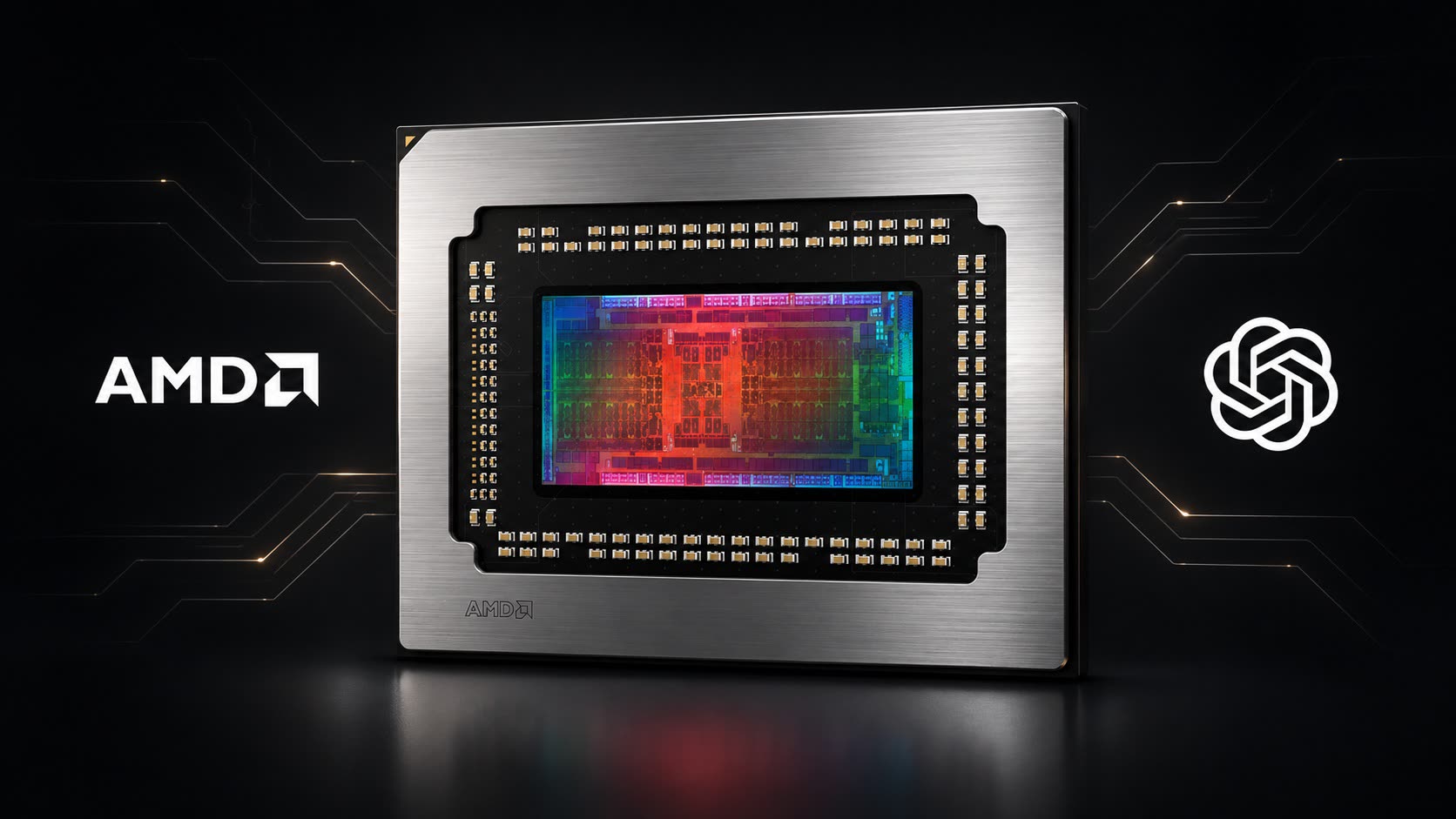
OpenAI says its AI models have helped AMD improve the design of next-generation processors, with GPU circuits recording gains of up to 14% across power, performance and area (PPA) metrics. The companies’ work used AI to analyze and rewrite parts of the hardware descriptions behind chip designs. According to OpenAI, the optimization effort achieved in less than five months was comparable to roughly a year of work by conventional chip-design teams.
How AI contributed to AMD’s chip design
The collaboration focused on hardware designs for future generations of AMD graphics processing units and central processing units. OpenAI says its engineers used AI models that have not been publicly identified to examine and optimize the designs.
The reported headline result is an improvement of up to 14% in PPA for GPU circuits. PPA is a key measure in semiconductor engineering because it captures the trade-offs between a chip’s power consumption, performance and physical area. Improving one dimension without compromising the others can be difficult, particularly as designs become more complex.
OpenAI also reported improvements of a few percent in CPU design. However, it did not disclose an exact figure for the central processing unit gains, so the GPU result remains the clearest quantified outcome in the announcement.
Rewriting SystemVerilog RTL to find optimizations
According to OpenAI, the AI system found new optimization opportunities by rewriting code used to describe a chip’s circuits. The work was carried out in SystemVerilog RTL, a hardware description approach widely used in the development of advanced digital chips.
RTL, or register-transfer level, describes how data moves between registers and how operations are carried out within a digital circuit. Changes at this level can affect the eventual implementation of a processor, including its speed, energy use and silicon footprint. The process is therefore more demanding than simply editing ordinary software: proposed changes must preserve the intended hardware behavior and meet strict engineering constraints.
OpenAI says its model was able to analyze and optimize RTL at a level comparable to a specialist in microprocessor architecture. The company describes the pace of progress as equivalent to compressing around 12 months of conventional design work into fewer than five months. This is OpenAI’s characterization of the project’s productivity, rather than a separately disclosed measurement of engineering hours.
Why PPA improvements matter
Power, performance and area are closely connected in processor development. A more efficient design can reduce energy requirements, improve operating performance, or make better use of limited silicon area. These gains can influence manufacturing costs, thermal demands and the amount of computing capacity that can fit within a given power envelope.
The reported 14% figure applies to GPU circuits and should not be read as a 14% increase in every aspect of a finished graphics card or processor. OpenAI has not provided a complete breakdown of the affected blocks, the baseline design, or how the improvements translate into end-product performance. The company says it expects further PPA gains for both AMD GPUs and CPUs as the work continues.
OpenAI’s earlier work on AI-designed chips
The AMD project is part of a broader effort to apply AI to semiconductor engineering. OpenAI previously worked with Broadcom on the development of OpenAI Jalapeño, a custom processor designed for AI inference workloads.
According to the information provided by OpenAI, engineering samples of Jalapeño were capable of running real workloads from June 2026. The company had expected an initial limited release in late 2026, followed by a broader rollout in 2027. Performance test results have also been reported, with claims that the chip offers lower energy consumption and latency than advanced Nvidia Blackwell GPUs in single-token prediction tasks. Those comparisons are specific to the stated workloads and should not be treated as a general claim of superiority across all applications.
Testing how GPT models optimize processor cores
OpenAI also described experiments designed to measure how well advanced GPT models can improve chip designs. Researchers asked the models to optimize the PicoRV32 and Ibex processor cores, giving each model a budget of 112,000 tokens at each stage.
The goal was to improve processor throughput, a measure that combines instructions per cycle (IPC) with the duration of each clock cycle. The designs submitted by the models were scored against defined constraints. A design received zero if it failed to function or if its area exceeded 16 times the original design. The strongest designs that met the test requirements received a score of one.
Researchers did not tell the models which workloads the resulting processors would need to run. OpenAI says GPT-6.2 Astra performed substantially better than the other models in the evaluation, ranking first on both the lowest overall cost measure and the highest optimization score.
Starting from specifications produced better results
A second experiment pointed to another important finding: AI models achieved better results when they redesigned the processor from its original specifications rather than limiting themselves to optimizing existing RTL code. That suggests the way a design task is framed can have a significant impact on the quality of AI-generated hardware solutions.
Specialized AI tools could shape the next stage
It remains unclear whether the AMD work relied on standard, unmodified GPT models or on specialized versions developed for chip engineering. Advanced and purpose-built large language models for these tasks already exist, although their use can be expensive.
OpenAI has also confirmed work with Synopsys on GPT-Synopsys, a specialized model intended to work with chip-design tools and automate related engineering processes. The initiative reflects a broader direction for AI in hardware development: moving beyond assistance with documentation or routine coding and into parts of the design and optimization process itself.
What the AMD collaboration could mean for chip development
The results announced by OpenAI suggest that AI could become a useful tool for exploring complex design alternatives more quickly. For AMD, better PPA results could help improve future processor designs, although the practical impact will depend on how the optimized circuits are integrated into products and validated through the full design and manufacturing process.
For the semiconductor industry, the project is another indication that AI-assisted engineering may shorten parts of the development cycle. Still, the reported figures are company-provided results, and further technical details will be needed to assess the methods, reproducibility and impact on commercial chips.